When speed becomes a matter of survival — Why artificial intelligence is changing not only technologies, but the economic framework itself
There are moments when you sense that a development isn’t just “important,” but is shifting everything. Artificial intelligence is such a moment. Not because it might change a lot someday. But because it’s already doing so—faster, deeper, and more broadly than many companies and their teams are yet willing to admit. The key message is this: We are not experiencing an ordinary wave of innovation. We are experiencing a phase of radical acceleration. AI models do not evolve linearly, but exponentially; what sounds far-fetched today may already be standard tomorrow.
That is precisely what makes the situation so fundamental. The new quality lies not only in better tools, faster answers, or more efficient workflows. It lies in the pace. In the speed at which AI’s performance, scope of application, and economic relevance are increasing. The underlying theories therefore speak of a potential “COVID moment”—that is, a point at which a development suddenly hits the everyday reality of business and society with full force.
For companies, this is a challenge in the best sense of the word. Because traditional planning approaches are coming under pressure. Those accustomed to thinking of technological changes in terms of annual budgets, pilot phases, and linear transformation programs could be left behind by reality. AI does not reward institutional sluggishness. It rewards learning curves, the pace of adoption, and the ability to understand what matters sooner than others. Put bluntly, one of the central takeaways is this: The greatest advantage right now lies in being early—early in understanding, early in adoption, early in adaptation.
This also changes the perspective on work. The debate is often oversimplified: Does AI replace jobs or not? In fact, the situation is more complex—and strategically more critical for many companies. It is not artificial intelligence as such that is replacing people across the board. But people who use AI intelligently will outpace others in productivity, quality, and speed. This is precisely the core of the shift. It is not just about automation, but about intensifying performance. Those who use AI effectively significantly increase their impact per hour, per decision, and per customer contact.
This doesn’t just apply to the tech world. The arguments presented here make it clear that routine tasks are being automated faster and more cost-effectively—not just in technical professions, but in virtually every knowledge-based activity. Wherever information is processed, content is created, decisions are prepared, or processes are coordinated, a new lever for productivity emerges. AI is thus not merely a toolbox. It is becoming the infrastructure of intellectual work.
And productivity is the real key concept. In an environment of demographic pressure, a shrinking workforce, and limited room for growth, productivity becomes the central economic issue. When fewer people have to do more, when markets become more demanding, and efficiency reserves shrink, AI is no longer just a nice add-on. It becomes an economic lever—perhaps even one of the most ly decisive levers of the coming years. The statements presented drive this point home clearly: It’s all about productivity.
The perspective extends far beyond software. Particularly interesting is the emphasis on an “Infrastructure First” approach: The future of AI lies not only in applications, but equally in computing power, hardware, networks, and physical systems. Anyone who thinks only of chatbots and assistants is missing the bigger picture. Automation, robotics, Physical AI, and the technical foundation for scalable AI are becoming the fields where the next level of productivity will be determined. Here, technology is not merely meant to make processes look nicer, but to elevate value creation to a new level.
Klaus Weinmann: “AI amplifies the best.”
Klaus Weinmann, CEO & Co-Founder
This is particularly relevant for sales-oriented, service-intensive, and knowledge-driven organizations. Because AI doesn’t just lighten the load. It amplifies. It accelerates preparation, research, prioritization, and communication. And that is precisely how it amplifies differences. The most succinct way to put it is this: AI does not replace sales—it scales the best. This is more than just a motivational phrase. It is a management thesis. In the future, success may depend less on team size alone and more on the ability to translate technology into results.
This also has cultural implications. The new reality is not kind to the hesitant. It demands a different way of thinking and acting, more speed, a greater willingness to experiment, and the courage to shed dead weight. In such phases, small, determined teams can be more effective than large structures that linger too long in a wait-and-see mode. Speed thus becomes a competitive factor in its own right. The fast ones don’t just gain time. They gain distance.
Perhaps that is the real point: AI does not just create operational advantages. It creates a new relationship with the future. Those who embrace it now with curiosity and urgency will build a lead that will likely be difficult to catch up with later. Those who hesitate too long, on the other hand, risk not only an efficiency problem but also a strategic lag. In the concluding thoughts presented, this is almost framed as a career message: This year could be one of the most important years for professional development—for all those who respond not with fear, but with a willingness to learn and consistency.
Conclusion
Artificial intelligence does not merely change processes. It changes the pace at which economic reality unfolds. That is precisely why it is not a niche topic for specialists, but a leadership issue. Those who understand, experiment with, and implement it now will gain not only efficiency gains but also strategic agility. The real danger does not lie in the technology itself. It lies in underestimating its momentum.
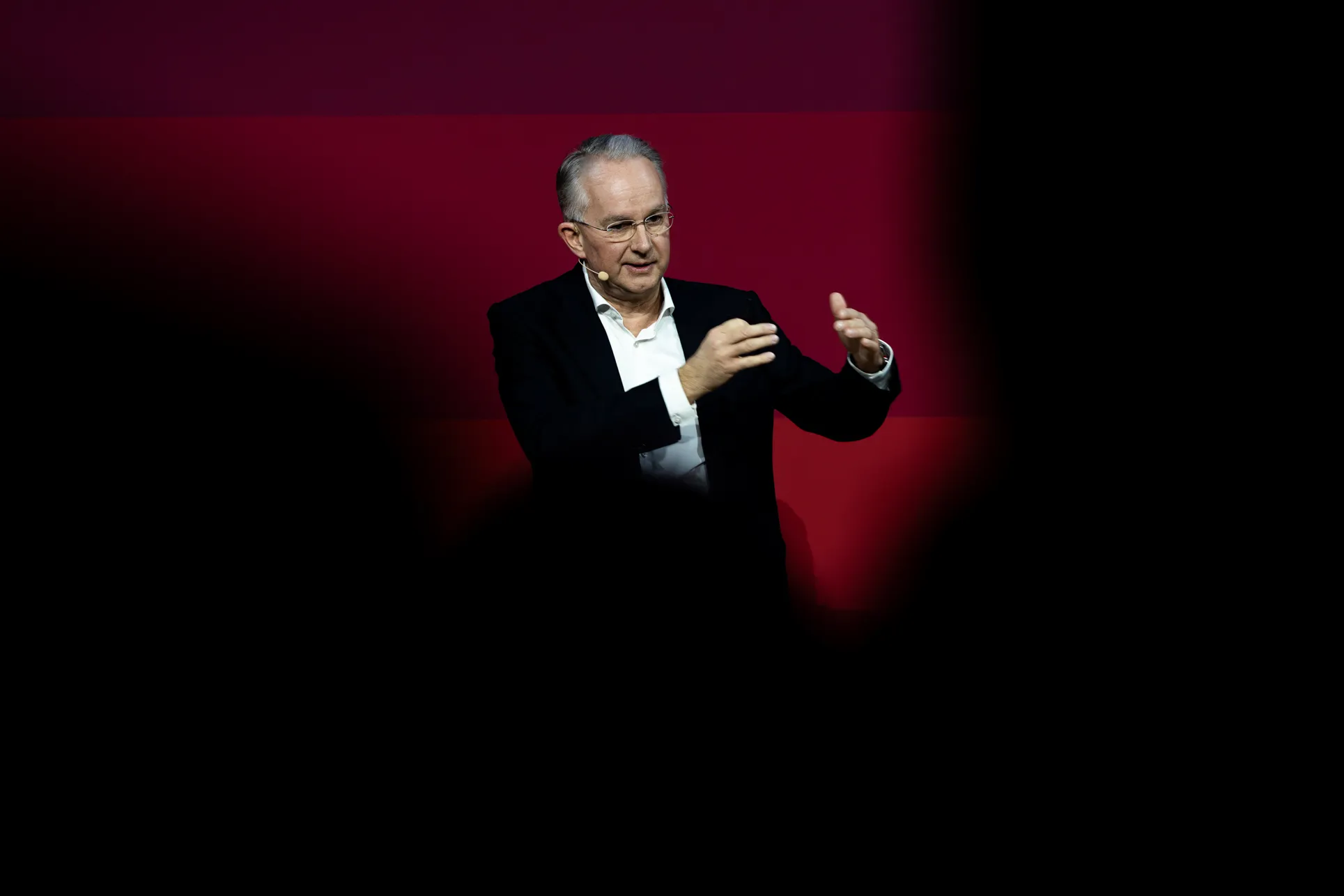
Photo: Klaus Weinmann at an event for sales staff and executives.